Tile Roofing Companies Near Me in Sarasota: Expert Guide to Repair & Replacement
When you search for tile roofing companies near me in Sarasota or Manatee County, you're not just looking for someone with a ladder and a nail gun. Tile roofing systems are fundamentally different from asphalt shingle roofs. They demand specialized knowledge about clay versus concrete materials, underlayment inspection, flashing details, and how Florida's subtropical climate attacks roofs from multiple angles—salt air, intense UV, hurricane-force winds, and relentless heat cycles. This guide walks you through what tile roofing specialists actually do, how to evaluate repair versus replacement, and why material choice matters far more than most homeowners realize.
Most homeowners in Sarasota hire the first roofer they find, unaware that tile roofing requires specialists who understand underlayment failure, moisture absorption rates, and hurricane wind loads in ways general contractors simply don't. Here's the twist that changes everything: your tiles might last 50+ years, but the underlayment beneath them—the actual water barrier—typically fails in 20–35 years. Knowing this difference could save you thousands in unnecessary replacements.
The Questions Every Sarasota Homeowner Should Ask
Before you call anyone, sit with these three questions. They'll shape every decision that follows.
- What's the real difference between a tile roofing specialist and a general roofer, and why does it matter for your Sarasota home?
- Is your tile problem actually a tile problem, or is the underlayment failing beneath perfectly good tiles?
- For Florida's climate, should you choose concrete, clay, or metal tiles—and what are the long-term cost and durability trade-offs?
Key Findings at a Glance
- Underlayment (the water barrier under tiles) fails every 20–35 years, far before the tiles themselves reach end-of-life; this is the primary failure point in most tile roof problems.
- Concrete tiles resist winds up to 180 mph but absorb 13% of their weight in water, making them more prone to frost damage and algae growth in humid Florida; clay tiles are less porous but more brittle under impact.
- A qualified tile roofing specialist inspects beyond the visible tiles, checking underlayment, flashing, fasteners, and structural support—identifying root causes that general roofers often miss.
- Repair versus replacement hinges on age, damage extent, and underlayment condition; isolated tile damage on a roof under 25 years with good underlayment usually favors repair over full replacement.
- The cost gap between concrete ($9–19/sq ft) and clay tiles ($12–21/sq ft) can mean $6,000–$10,000 difference on a typical 2,000 sq ft roof, influencing your material choice.
Our Methodology
This guide synthesizes expertise from Florida-based tile roofing specialists, hurricane-resistant material standards, and local climate data specific to Sarasota and Manatee County. We evaluated material durability claims against real-world Florida conditions, analyzed cost-benefit scenarios for homeowners facing repair decisions, and examined what distinguishes specialist tile roofing companies from general contractors. Every statistic and lifespan projection reflects conditions in Florida's subtropical climate, with high humidity, salt air exposure, and category 3–5 hurricane wind loads.
1. Tile Roofing Companies Near Me: Why Specialists Matter More Than You Think
General roofers are often very good at what they do—speed, basic visual inspection, getting shingles down fast. But tile is a different animal. A tile roofing specialist diagnoses root causes instead of patching symptoms, and that distinction shows up the moment they climb onto your roof. Where a general contractor walks the perimeter and eyeballs obvious cracks, a specialist treats the roof as a system: tiles, underlayment, flashing, fasteners, and the structure underneath, all working together.
A thorough tile roof inspection includes an underlayment assessment (often requiring attic access), a check of flashing integrity at every penetration point, an evaluation of fastener condition after years of thermal expansion and wind stress, and a look at whether the structural support can still handle the load. Skip any of these steps and you're guessing, not diagnosing.
This is exactly where misdiagnosis happens. Water intrusion from failed underlayment often gets blamed on "a bad tile" when the tile itself is perfectly intact—the water is simply finding its way past a degraded barrier underneath. Similarly, slipped tiles are frequently chalked up to gravity or age when the real culprit is fastener failure, something only a close inspection reveals.
Local knowledge compounds all of this. Sarasota and Manatee County have HOA architectural requirements, wind load certification standards tied to Florida Building Code, and distinct salt-spray damage patterns near the coast versus inland neighborhoods. A roofer who's only worked shingle jobs in another state won't know to check for these things—and won't know what questions your HOA board is going to ask when you submit a permit.
If you want a deeper breakdown of what sets tile specialists apart from general roofers, it's worth reading before you make any calls.
- A specialist tile inspection takes 2–3 hours and goes into crawl spaces and attics; a general roofer's walk-around takes 20 minutes from the ground.
- Underlayment failure is silent: no visible signs until water stains appear inside your home, often years after the barrier has degraded.
- Tile specialists carry insurance and credentials specific to tile roof work (not just general roofing licenses).
- Ask prospective contractors: "How many tile roofs have you inspected and repaired in Sarasota in the past five years?" If they hesitate, keep looking.
2. Concrete vs. Clay Tiles: Which Material Suits Florida's Climate Best?
Concrete tiles are the affordable entry point for most Sarasota homeowners, and for good reason—they're widely available and competitively priced. But that affordability comes with a trade-off: concrete's higher porosity, around 13% water absorption, means it acts like a slow sponge. Over years of Florida's humidity and occasional cool snaps, that absorbed moisture contributes to algae growth, surface wear, and—in rare freeze-thaw scenarios—internal cracking as trapped water expands.
Clay tiles sit on the other end of the spectrum. Their lower porosity (roughly 5% water absorption) and baked-in color give them superior color stability and better resistance to moisture-driven degradation. The trade-off is brittleness: clay tiles crack more readily than concrete under impact from hurricane debris or hail, so in storm-prone zones that's a real consideration, not a footnote.
There's also a hidden cost with concrete that doesn't show up in the initial quote: repainting or resealing every 15–20 years to maintain appearance and keep water penetration in check. Skip that maintenance and you'll see fading, staining, and reduced water resistance creep in faster than expected.
Metal tile roofing deserves a mention here too, since it's increasingly common in Sarasota renovations. It's lightweight—about half the load of clay or concrete—reflects solar heat in a way that can lower cooling costs by an estimated 15–25%, and performs identically to concrete in wind resistance testing.
| Tipo de teja | Vida útil en Florida | Porosidad / Absorción | Resistencia a vientos |
|---|---|---|---|
| Arcilla | 50-100+ años | Baja (~5%) | Hasta 150 mph |
| Concreto | 40-50 años | Alta (~13%) | Hasta 180 mph |
| Metal | 40-70 años | No aplica | Hasta 180 mph |
- In Florida's salt-spray zones (Sarasota Bay, Gulf Shores), clay's lower porosity provides a small edge in corrosion resistance.
- Concrete tiles require more maintenance: periodic treatment with algae inhibitors and sealants every 15–20 years.
- Metal tiles appeal to homeowners who want tile aesthetics without the weight penalty; structural engineers may approve metal on older homes where concrete would require reinforcement.
- For HOA-governed communities, confirm material restrictions before ordering; some HOAs mandate clay for historical continuity.
3. Tile Roof Repairs vs. Full Replacement: Making the Financial Case
Not every problem calls for a new roof, and good tile roof repairs can extend the life of a system by decades when the underlying structure is sound. Repair is usually the right call when you're dealing with a handful of cracked tiles, slipped tiles from wind events, minor flashing damage, or isolated underlayment failure confined to one area.
Replacement becomes the smarter path when underlayment failure is widespread—water stains showing up inside the home, visible rot in the decking—when the roof is past 25 years old, or when multiple zones are failing independently rather than one isolated spot.
Here's the repair math in practice: if your roof is under 25 years old and the damage is isolated, repair costs typically run $500–$2,000 and buy you another 15–20 years of service. That's a strong return on a modest investment, assuming the underlayment elsewhere is still healthy.
But if underlayment is failing across 30% or more of the roof, repair costs start piling up fast, and replacement usually becomes the more cost-effective choice within 5–7 years of ongoing patch jobs. At that point you're not solving the problem—you're renting time.
There's a financing angle worth weighing too: factor in how long you plan to stay in the home. If you're selling within 5 years, a well-executed repair may be entirely sufficient. If you're staying 20+ years, investing in better materials during a full replacement often pays off in reduced maintenance and fewer future surprises.
- Underlayment replacement (without tile removal) costs $3,000–$8,000 and is often wiser than a full re-roof if tiles are still sound.
- Most insurance claims for storm damage cover full replacement if damage exceeds 20% of roof area—know your policy.
- Tax credits or energy rebates may apply to metal tile roofs (heat reflection reduces A/C load); consult a tax advisor.
- Avoid the "piecemeal repair trap": multiple small repairs over 3–5 years can cost as much as a planned replacement.
For a structured way to think through this decision, our repair versus replacement decision-making framework walks through the same logic applied to other roof types, which is useful context even for tile.
4. Understanding Underlayment and Flashing: The Real Water Barriers
Think of a tile roof like a layered defense system. The visible tiles are the outermost soldiers—tough but not impervious. The underlayment is the fortress wall behind them, stopping water before it reaches the castle, which is your home. When the underlayment fails, invaders in the form of water and rot slip past even strong outer tiles. Most homeowners focus on replacing the soldiers—the tiles—when they should be maintaining the fortress wall underneath.
Underlayment's job is simple but critical: it captures water that penetrates tiny cracks or gaps in the tiles and channels it safely off the roof, or absorbs it before it ever reaches the decking. In Florida, you'll typically encounter synthetic underlayment (polypropylene-based, with a 30–50 year lifespan) or traditional felt (20–30 years). Modern builds increasingly favor synthetic for its longer service life and better moisture resistance.
Concrete's 13% water absorption matters here in a specific way. It acts as a minor sponge, and in the rare freeze-thaw cycles Florida does experience, absorbed water can expand and crack tiles from the inside out—a slow, cumulative process most homeowners never see coming until it's visible.
Flashing failures are the second-most common failure point after underlayment. Wherever tiles meet chimneys, vents, valleys, or roof edges, you've got a seam—and seams are where water finds its way in. These transition points deserve just as much scrutiny as the tiles themselves.
Watch for these signs of underlayment failure: water stains on attic insulation, soft spots in the roof deck when walked on, dark patches visible under the eaves, or mold developing in attic spaces. None of these show up from the ground, which is exactly why attic access matters during inspection.
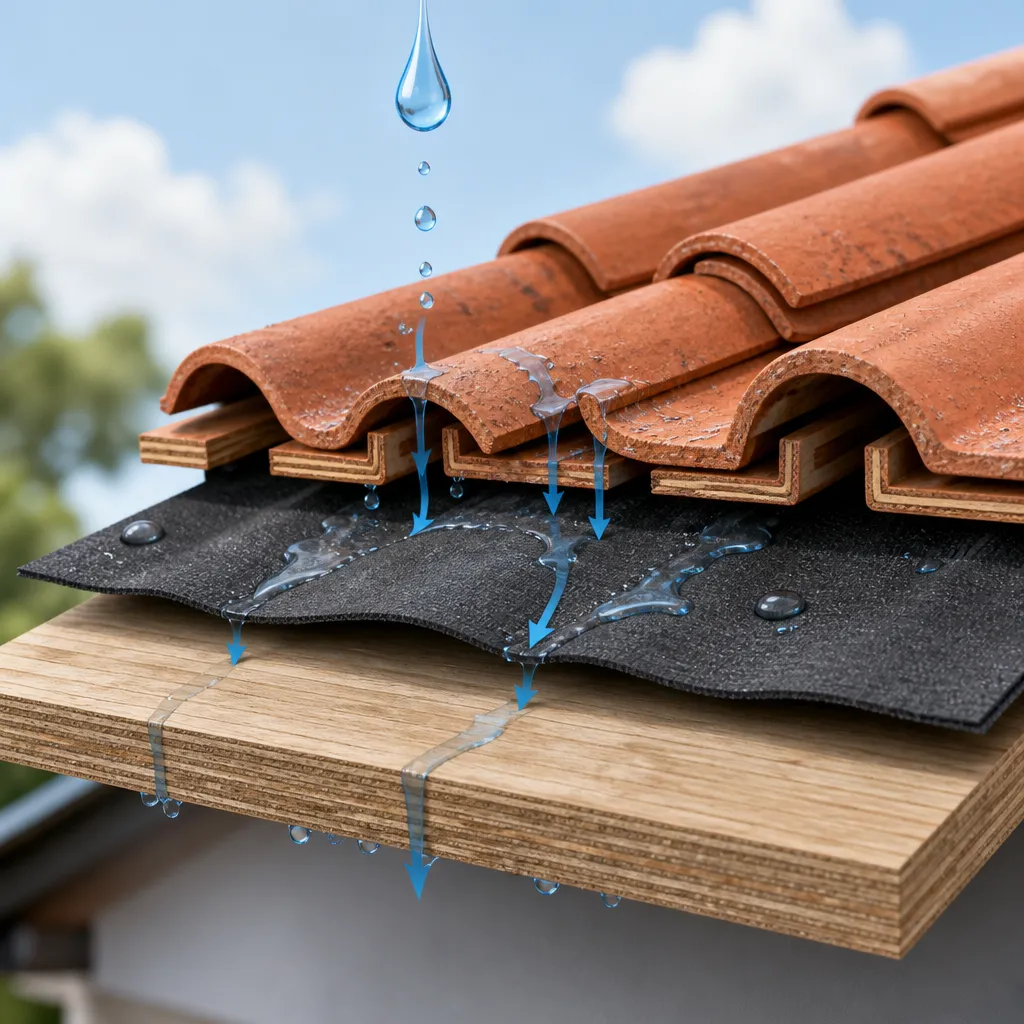
Here's a real example of how this plays out. A Sarasota homeowner noticed water stains on an upstairs bedroom ceiling, assumed a cracked tile was the culprit, and called a general roofer. The roofer quoted $8,000 for partial re-roofing. A specialist tile company came next: they found the visible tiles were fine, but the underlayment beneath had rotted through after 28 years in Sarasota's humid climate. For $5,200, they replaced just the underlayment and flashing in that zone, buying another 25+ years of performance. A year later, no stains—because the actual problem was fixed, not masked.
- Replacing underlayment without removing all tiles (surgical replacement) costs 30–40% less than full re-roofing but requires specialist skills.
- Flashing repairs often address water intrusion before it reaches underlayment; catching flashing problems early saves big money.
- Metal tile roofing eliminates water absorption concerns entirely—metal doesn't absorb water—but flashing and underlayment still matter.
- In Sarasota's high-humidity climate, ensure underlayment has proper ventilation; poor ventilation traps moisture and accelerates underlayment decay.
If a storm has already caused visible damage, it's worth understanding how water intrusion and underlayment damage occur in storm conditions before you file a claim.
5. Metal Tile Roofing: A Modern Alternative for Sarasota Homes
Metal tile roofing is gaining real traction in Sarasota, and it's not just a trend—it's a legitimate alternative with distinct advantages. A 40–70 year lifespan, zero water absorption, and solar reflectance that can cut cooling costs by an estimated 15–25% make it worth serious consideration, especially for homeowners planning to stay put for decades.
There's a persistent myth that metal tile looks "metallic" or industrial. In reality, modern metal tiles come in finishes designed to mimic clay and concrete profiles closely—from the street, most people can't tell the difference.
The lightweight advantage is significant for older homes. Metal tiles weigh roughly 50% less than clay or concrete, meaning some older structures can accommodate the material without costly reinforcement—an upfront savings that can offset the material's higher per-unit price.
Noise is a common concern homeowners raise, and it's a fair question. Modern metal tiles installed over solid underlayment perform about as quietly as traditional tile during rain or hail; noise issues typically trace back to poor installation, not the material itself.
In salt-spray zones along Sarasota Bay and the Gulf, properly coated and fastened metal tiles can outlast concrete in corrosive environments, with clay also holding up well against salt air exposure.
- Metal tile roofing qualifies for energy efficiency tax credits in some Florida jurisdictions; check with your county.
- Fastener corrosion is a concern with cheap metal tiles; specify stainless-steel or coastal-grade fasteners in Sarasota.
- Mixed-material repairs (adding metal tiles to an existing clay roof) create visual and performance mismatches; plan for consistency.
- Hail resistance: metal tiles perform better than clay (less brittle cracking) but slightly worse than concrete under extreme impact.
6. What to Expect During a Professional Tile Roof Inspection
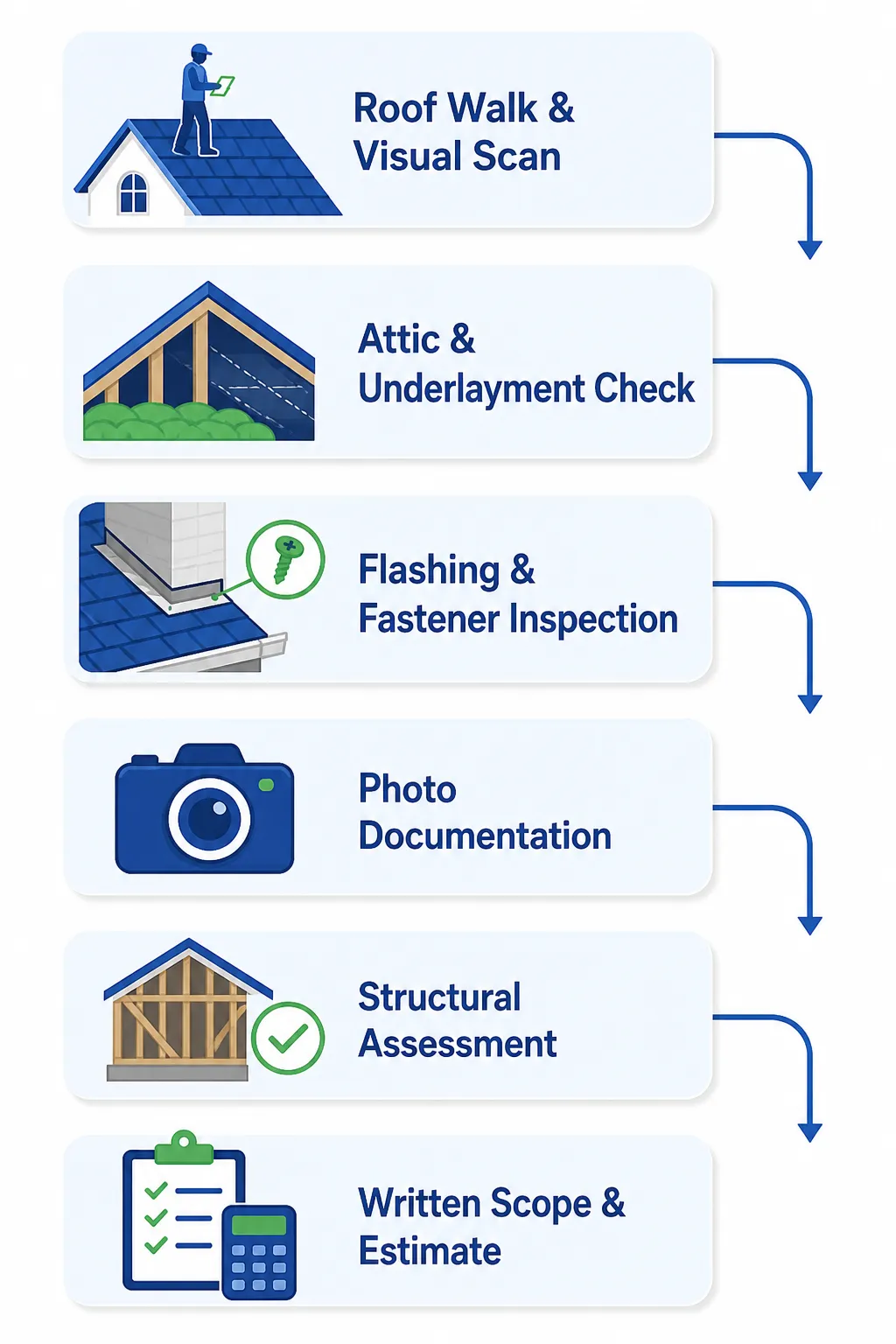
A proper roof tile repair process always starts with a proper inspection, and that inspection follows a consistent sequence if the contractor knows what they're doing. Here's what a thorough evaluation actually looks like, step by step.
It starts with an exterior visual scan—checking for cracked, slipped, or missing tiles, visible flashing damage, and general surface wear. From there, the specialist moves into the attic to assess underlayment condition directly, looking for water stains, soft spots, or signs of mold and rot that never show up from outside.
Next comes a close-up flashing examination at chimneys, vents, valleys, and roof edges—the highest-risk zones for water intrusion. A fastener pull-test, done by sampling a representative section, confirms whether nails or screws are still holding tiles securely after years of wind events and thermal cycling.
A structural evaluation follows, checking whether the decking and supports can handle the load of a potential replacement—especially important if you're considering upgrading to heavier clay tile from a lighter material. Finally, you should receive a comprehensive written estimate with photos, clearly identifying repair candidates and a recommended timeline.
- Ethical tile specialists won't pressure you into immediate full replacement; they'll itemize repairs by priority and timeline.
- A thorough inspection takes 2–4 hours; if a contractor finishes in 20 minutes, they're not assessing underlayment or structure.
- Request photos of attic conditions and underlayment state; this transparency builds trust and informs your repair-versus-replace decision.
- Red flags in an inspection: vague language ("roof looks bad"), no mention of underlayment, no photos, pressure to decide same-day.
Want to make the most of your inspection appointment? Review our guide on preparing for a professional roof inspection visit, and once you're ready to compare bids, see our tips on vetting and selecting a specialist contractor.
What This Means for Sarasota Homeowners, HOAs, and Property Managers
These findings carry real weight for anyone managing a tile roof in Sarasota or Manatee County, whether it's one home or a whole community of them.
- Repair decisions must account for underlayment age, not just tile condition; a 28-year-old roof with failed underlayment is a replacement candidate even if tiles look sound.
- Material choice (concrete vs. clay vs. metal) should reflect your timeline and budget, not just aesthetics; clay costs more but lasts decades longer in Florida.
- Hiring a tile specialist instead of a general roofer saves money by diagnosing root causes and avoiding unnecessary full replacements; the inspection cost ($300–$500) pays for itself in wiser decisions.
- HOAs and property managers should mandate tile specialist inspections every 10 years and budget for underlayment replacement at year 25–30, regardless of tile appearance.
- Storm-hardened Sarasota homes benefit most from metal tile roofing, which combines wind resistance (180 mph), longevity (50–70 years), and heat reflection—offsetting higher upfront cost over time.
Frequently Asked Questions
How do I know if I need a tile roof repair or a full replacement?
It mostly comes down to underlayment condition and age. If your roof is under 25 years old with isolated damage and healthy underlayment, repair is usually sufficient. If underlayment is failing across 30% or more of the roof, or you're seeing interior water stains, replacement becomes the more cost-effective path.
What's the difference between tile roofing companies near me and general roofing contractors?
Tile specialists inspect beyond the visible tiles—checking underlayment, flashing, fasteners, and structural support—while general roofers often rely on a quick visual walk-around. That deeper inspection catches problems like underlayment failure that general roofers frequently misdiagnose as tile damage.
Is concrete or clay tile better for my Sarasota home?
It depends on your priorities. Concrete offers higher wind resistance (up to 180 mph) at a lower upfront cost but absorbs more water and fades faster. Clay costs more but resists moisture better and holds its color for 50+ years, making it a stronger long-term investment if you're staying put.
How often does tile roof underlayment need to be replaced?
Underlayment typically fails every 20–35 years, depending on the material (synthetic lasts longer than felt) and installation quality. Since tiles themselves can last 50+ years, most tile roof maintenance work later in a roof's life involves underlayment replacement, not tile replacement.
Is metal tile roofing a good fit for older Sarasota homes?
Often, yes. Metal tile weighs about half as much as clay or concrete, so many older structures can handle it without costly reinforcement. It also offers strong wind resistance and solar reflectance, though HOA approval may be required even when the finish closely resembles traditional tile.
Keep Learning
- Residential Roofers Near Me in Sarasota & Manatee County: What Sets Them Apart — Learn how to distinguish a true tile specialist from a general roofing contractor, including licensing, experience, and local compliance knowledge specific to Sarasota.
- Roof Fixers Near Me: A Pre-Arrival Checklist for a Faster Fix — Prepare for your tile roof inspection with this checklist, ensuring you gather photos, document problem areas, and ask the right questions to get an accurate estimate.
- Top Roofers Near Me in Sarasota & Manatee County: How to Vet Local Contractors — Deep dive into vetting criteria: licenses, insurance, references, warranty terms, and red flags to watch for when hiring a tile roofing specialist.
- Storm Damage Roof Repair Near Me: Sarasota & Manatee County Homeowner's Guide — After hurricanes or severe weather, tile roofs are vulnerable to underlayment and flashing damage. Learn how to document claims and navigate insurance coverage for tile roof repairs.