Roof Maintenance Near Me: Scope & Schedules for Sarasota & Manatee County
When you search "roof maintenance near me," you're probably reacting to a leak, a dark stain, or an insurance agent's warning. But roof maintenance near me in Sarasota or Manatee County works best as a plan, not a panic. Local roofs don't last 25 years like they do in colder states—they last 15 to 20 because of relentless heat, humidity, and salt air. This guide walks you through what scope of maintenance actually protects your roof, when to schedule it, and why documented prevention keeps your homeowners insurance active.
Most homeowners in Sarasota and Manatee County treat roof maintenance as a reactive afterthought, waiting for visible damage before calling a contractor. By then, a $400 annual inspection could have prevented a $5,000 restoration. Florida's subtropical climate—extreme UV (8–10 index), coastal salt spray, and hurricane season stress—makes your roof expire 10 years earlier than roofs up north. Two well-timed inspections per year aren't a luxury; they're the difference between keeping your insurance and fighting non-renewals.
Before diving in, here are the three questions local homeowners ask us most often:
- What exactly does "roof maintenance" include, and how is it different from a full restoration?
- How often should I have my roof inspected in Sarasota or Manatee County—and why twice a year?
- Can proof of regular maintenance prevent insurance non-renewals under Florida's strict underwriting rules?
Key Findings
- Asphalt shingle roofs in Sarasota and Manatee County last only 15–20 years (vs. 25–30 years up north) due to UV index 8–10 and coastal humidity.
- Preventive maintenance ($250–$600 annually) stops small issues before they trigger restorations ($3,000–$7,000) or full replacements ($15,000+).
- Documented inspections—especially before hurricane season—are now a factual requirement to maintain active homeowners insurance policies in Florida.
- Florida's 25% damage rule: if deterioration exceeds one-quarter of your roof's surface, building code may mandate full replacement rather than piecemeal repair.
- Routine maintenance extends roof life by 5–10 years beyond its expected cycle when done consistently and documented properly.
Methodology
This guide synthesizes research from the NRCA (National Roofing Contractors Association), Angi's maintenance studies, Florida Building Code requirements, and industry lifespan analyses specific to coastal Florida. We interviewed local roofers and insurance agents in Sarasota and Manatee County to understand what "roof maintenance near me" actually means in a subtropical, high-humidity, hurricane-prone climate. Cost ranges reflect 2025 pricing for residential asphalt shingle roofs in Southwest Florida; commercial flat roofs may differ. All recommendations align with Florida's regulatory environment and homeowners insurance underwriting standards.
1. What Roof Maintenance Near Me Actually Covers: A Complete Scope
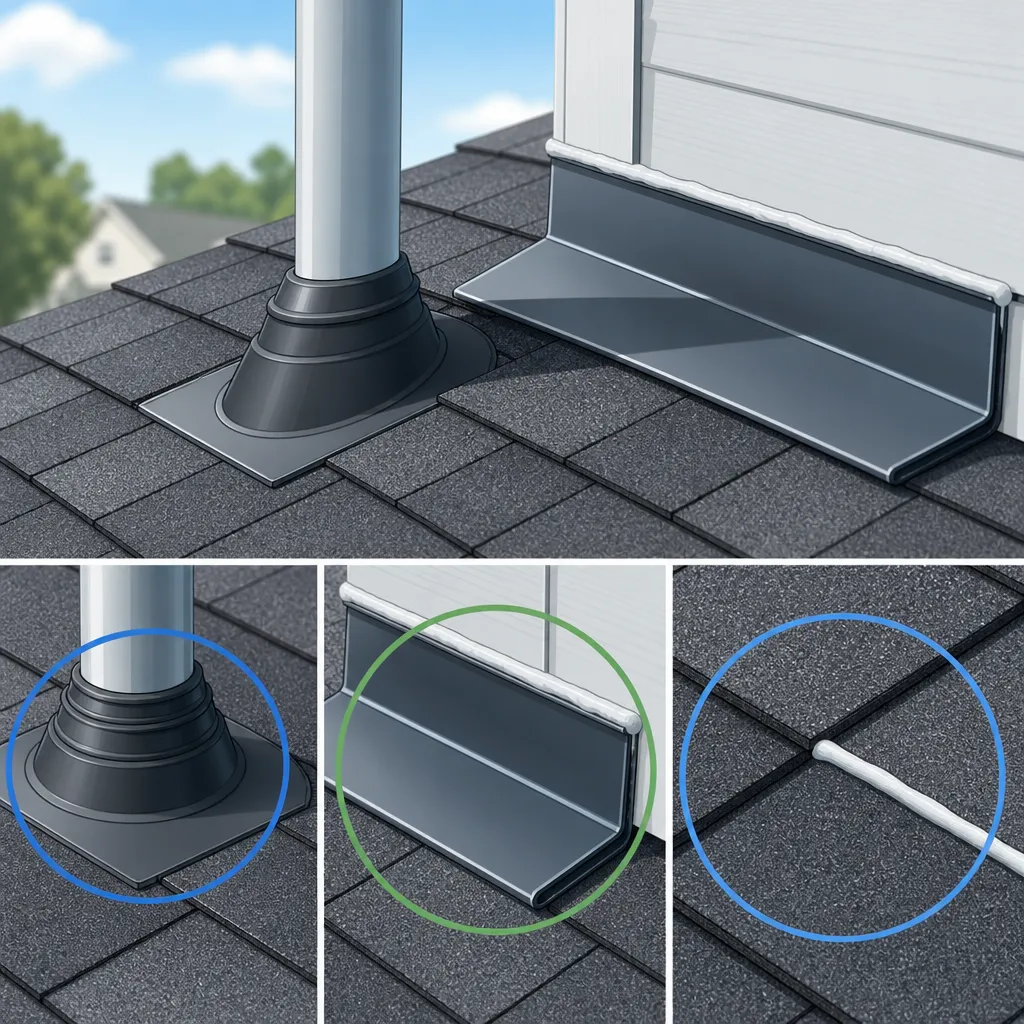
People hear "roof maintenance" and picture a guy walking around with a flashlight for ten minutes. That's not what a real inspection looks like, and it's not what protects you from a surprise leak or an insurance denial. A proper scope covers six specific checkpoints, each tied to a failure mode that shows up repeatedly on Sarasota and Manatee County roofs.
Flashing inspection comes first. The metal edges around chimneys, valleys, and roof penetrations are where water collects and where seams eventually separate. A technician checks for lifted edges, rust streaks, and gaps where caulking has pulled away from the metal.
Vent boot and collar seals matter more here than almost anywhere else in the country. The rubber gaskets around plumbing vents deteriorate fastest in salt-heavy coastal air—faster than the shingles around them, in fact. A cracked boot is one of the most common sources of a slow attic leak that homeowners don't notice until there's a ceiling stain.
Elastomeric sealant review follows. Flexible caulk used around flashings and penetrations cracks under UV and thermal stress within 3–5 years, even when the rest of the roof looks fine. This is cheap to fix proactively and expensive to ignore.
Then there's the visual everyone recognizes but few understand: Gloeocapsa magma, the black algae streaking across shingles. It doesn't just look bad—it traps moisture against the shingle surface and accelerates granule loss and decay underneath the stain.
A thorough visit also includes a drainage assessment—clearing gutters and downspouts, and confirming that standing water isn't sitting on any flat sections or valleys—plus photographic documentation that becomes a digital record for your insurance file and for the next contractor who works on your roof.
- A solid inspection takes 45–90 minutes for a typical residential roof; don't trust anyone who rushes through it.
- Mobile app inspections with instant photos let you track conditions year to year—essential for proving maintenance to insurers.
- Scope differs from restoration: maintenance is "look, clean, reseal." Restoration involves replacing sections or re-coating.
If you want to know exactly what to prepare before a roof inspector arrives, it's worth a quick read before your first appointment—clearing attic access alone saves time on the visit.
2. How Often Should You Schedule Roof Maintenance in Sarasota & Manatee County?
One inspection a year is the national default. It's not enough here. Sarasota and Manatee County roofs face stressors—UV, humidity, salt, storms—on a schedule that doesn't line up neatly with a single annual visit, so the real answer is twice a year, timed around hurricane season.
The spring inspection (March–April) catches winter damage, checks sealants before the summer heat and humidity spike, and leaves time for repairs before hurricane season officially begins on June 1. This is the visit that actually matters most, because it's your last clean window to fix anything before storms arrive.
The post-storm walk (August–September) is a visual check after heavy rain or tropical activity. Don't wait for an insurance adjuster if damage looks obvious—lifted shingles, exposed underlayment, or debris punctures need attention immediately, not whenever a claims queue clears.
The fall inspection (October–November) is a thorough review after peak hurricane season. It's when you plan winter repairs and, importantly, document everything for your upcoming renewal cycle.
Why does twice yearly matter so much in Florida specifically? UV and humidity are constant stressors here, not seasonal ones. Coastal salt spray accelerates wear year-round, and insurance companies now expect documented bi-annual checks as part of underwriting. A single annual visit simply can't catch everything that happens between visits in this climate.
As for DIY versus professional: a visual walk-around yourself is genuinely useful for catching obvious problems early, but you still need a licensed contractor for the official inspection. Your insurance company wants that report on file—a homeowner's phone photos don't carry the same weight.
- Single annual inspections miss storm damage and seasonal stressors unique to Florida's coast.
- Insurance renewals often hinge on proof of two inspections per year; absence of that record is grounds for non-renewal.
- Schedule inspections 4–6 weeks before your insurance renewal date so you have documentation ready.
Choosing who does these inspections matters as much as the schedule itself. Here's how to vet local contractors for reliable inspections before you commit to a maintenance plan.
3. Roof Maintenance vs. Roof Restoration: Know the Difference Before You Pay
| Tipo de intervención | Costo estimado |
|---|---|
| Mantenimiento preventivo anual | $250–$600 |
| Restauración de daño moderado | $3,000–$7,000 |
| Reemplazo completo de techo | $15,000+ |
Contractors throw around "maintenance," "restoration," and "replacement" like they're interchangeable. They're not, and confusing them is how homeowners either overpay for something small or underpay for something that needed a bigger fix.
Maintenance is preventive. It stops small leaks before they rot decking and framing—think inspection, cleaning, sealant touch-ups, and algae removal. Restoration addresses early-stage damage: you've caught deterioration at 5–15% of the surface area, not yet the 25% threshold that changes everything.
That threshold is the key line in Florida building code. Replacement is mandatory when damage exceeds 25% of roof surface, or when structural integrity is compromised. Past that point, piecemeal repair isn't legally an option—you're required to replace the affected roof section, often the entire roof.
The math behind reactive roofing is brutal. Waiting for catastrophic failure instead of planning for incremental care means your costs across a 20-year cycle nearly double compared to a planned maintenance approach. And increasingly, some carriers now require proof of maintenance attempts before they'll even approve a full replacement claim—so skipping maintenance doesn't just cost more, it can cost you coverage.
- A small $400 repair caught in year 3 prevents a $5,000 restoration in year 8 and a $20,000 replacement in year 15.
- Document every maintenance visit with photos and receipts—they're your proof of diligence if insurance questions arise.
- Neglecting maintenance may void coverage or trigger non-renewal; performing it keeps your policy active and rates predictable.
For a closer look at where the line sits between repair and full restoration, this guide on diagnosing when repair is enough vs. needing full restoration breaks down the decision points in more detail, especially relevant if you manage a flat-roofed commercial property.
4. Why Asphalt Shingles in Florida Last Only 15–20 Years: The Climate Factor
| Región | Vida útil esperada (años) |
|---|---|
| Florida (UV 8–10, humedad costera) | 15–20 |
| Estados del norte (UV moderado) | 25–30 |
Homeowners who move to Sarasota or Manatee County from colder states are often shocked when their roofer tells them to expect 15–20 years instead of the 25–30 they were used to. It's not a warranty gimmick or a sales tactic—it's the climate, and it's measurable.
UV degradation leads the list. Southwest Florida sits at a UV index of 8–10, compared to 4–6 up north. That extra ultraviolet exposure breaks down the asphalt binder in shingles noticeably faster, year after year, regardless of brand or installation quality.
Coastal salt spray compounds the problem. Salt crystals accelerate corrosion of metal flashing, fasteners, and vent pipes. They also embed into shingle surfaces and trap moisture there, which speeds up granule loss.
Humidity and mold add another layer. With 85%+ annual humidity in Sarasota and Manatee County, algae grows readily on roof surfaces, and Gloeocapsa magma spreads across shingles whenever it isn't cleaned proactively.
Then there's hurricane wind and rain—an annual storm season that subjects roofs to lateral stress and water infiltration risk that temperate climates simply don't face. Add in thermal cycling, where daily heat followed by afternoon thunderstorms creates micro-expansion and contraction, loosening fasteners and cracking sealant over time, and you get a roof under constant mechanical and chemical stress.
This is why maintenance extends life so dramatically here: regular sealant refresh, algae removal, and fastener checks delay the exact breakdown processes that Florida's climate accelerates.
- Your roof isn't failing early because it's defective; it's failing on schedule for a coastal subtropical environment.
- Shingles rated for 25–30 years up north are honest—in that climate. In Florida, you'll get 15–20 because the stressors are different.
- Accepting this reality means budgeting for maintenance now and replacement sooner; it's not a design flaw, it's geography.
Material choice matters too, especially if you're weighing options during a replacement decision—local roofers understand which products hold up under Florida-specific conditions. Here's why local roofers understand Florida-specific material choices in more depth.
5. How Documented Roof Maintenance Prevents Insurance Non-Renewals in Florida

Florida's insurance market has tightened considerably. Carriers are pulling out of the state or raising underwriting standards, and non-renewal threats for homeowners—especially those with aging roofs—are real and increasingly common.
Here's the documentation trap most homeowners fall into: insurers now require proof of regular maintenance to renew policies, especially for homes over 10 years old. Nobody tells you this until renewal time, and by then it's too late to retroactively prove you did anything.
So what counts as "proof"? Timestamped photos from inspections, written reports from licensed roofers, copies of completed repairs, and dated receipts. A verbal assurance that "the roof's fine" means nothing to an underwriter.
This connects directly back to the 25% rule from Section 3. If an adjuster finds damage exceeding 25% of the roof surface and there are zero maintenance records on file, insurers may deny coverage outright or mandate full replacement before they'll renew—leaving you to cover costs that a documented maintenance history might have mitigated.
To document correctly: hire a licensed contractor, get an itemized report with photos, store digital copies in cloud storage, and provide copies to your insurer proactively at renewal time rather than waiting to be asked.
Red flags that commonly trigger non-renewal include missing inspection records, visible algae or moss, damaged flashing, water stains in the attic, and no proof of timely repairs. Any one of these on its own might be manageable; several together paint a picture of neglect.
- Your insurance agent may not ask for maintenance records until renewal—by then, it's too late to retroactively prove you maintained the roof.
- Proactive homeowners create a maintenance folder 3–6 months before renewal, compile all inspection and repair records, and submit to agent unsolicited.
- A single year of missing inspections can justify non-renewal under Florida's current regulatory environment; consistency matters.
Property managers and commercial owners often have an easier time with this because they already run structured recordkeeping. If you manage multiple properties, commercial contractors often have better documentation systems for institutional clients, and it's worth borrowing that approach for a single-family home.
6. The Cost Reality: Preventive Maintenance Saves 100% Over the Roof's Lifecycle
Let's run the actual numbers, because this is where the abstract argument for roof maintenance near me becomes concrete. The annual cost baseline for two inspections, cleaning, and minor sealant work runs $250–$600 per year.
Now compare two realistic scenarios. In the reactive scenario, a homeowner skips maintenance for five years, encounters a $4,500 restoration when problems finally surface, then faces another $3,000 in repairs three years later, followed by an accelerated full replacement well ahead of schedule.
In the preventive scenario, that same homeowner spends roughly $400 per year for five years—$2,000 total—catches one minor $800 repair early in year six, and extends the roof's functional life to a full 20 years without ever facing a crisis-level bill.
The compounding effect is what makes reactive maintenance so expensive: one missed inspection can chain into cascading damage. A small leak becomes rot, rot becomes structural damage, and structural damage means full replacement instead of a modest repair.
There's an insurance angle here too. Consistent maintenance may help stabilize premiums or prevent non-renewal, while reactive damage increases claims frequency and can trigger rate hikes or outright cancellations. Run the ROI math over 20 years: roughly $6,000 spent on maintenance saves $8,000 or more in emergency repairs and replacement delays—and that's before counting the value of insurance stability.
- The "wait and see" approach feels cheaper at first (no $400 inspection this year), but it's statistically the most expensive strategy over time.
- Every year without maintenance increases the probability that next year's storm or summer heat will trigger a five-figure repair.
- Homeowners who maintain actually refinance more easily and sell faster—inspectors spot maintenance records and reduce buyer risk premium.
Worth noting: these cost profiles shift if you have tile instead of asphalt shingle—tile roofs have different maintenance profiles and costs that are worth understanding separately.
Think of It Like Your Roof's Annual Physical
Roof maintenance is your roof's annual physical. Just as a healthy person gets checked yearly to catch early signs of hypertension or high cholesterol before they become crises, a roof needs regular inspection to catch UV cracks and seal failure before they become water damage and rot. Ignoring the physical because you "feel fine" is how minor issues become major surgery. Florida's harsh climate is like a chronic condition; consistent oversight isn't optional—it's preventive medicine.
A Real Example: The Cost of Skipping Two Years
A Sarasota homeowner skipped two years of inspections to save money. In year 3, a post-storm inspection revealed deteriorated flashing around a vent pipe, algae buildup on half the roof, and cracked sealant in three valleys. The contractor quoted $4,800 for restoration—sealing the flashing, power-washing the algae, replacing cracked sealant, and reinforcing two small soft spots.
Had the homeowner spent $400 a year on maintenance inspections and cleaning, that damage would have been caught and stopped at a cost of $800 total—one minor sealant refresh and algae cleaning. Instead, the delayed approach cost six times more.
What This Means for Homeowners in Sarasota & Manatee County
- Adopt a "plan, don't panic" mindset: schedule bi-annual inspections (spring and fall) now, not after visible problems appear. Insurance underwriters expect this cadence.
- Build a maintenance documentation habit: every inspection, cleaning, and repair gets timestamped photos and filed digitally. This folder is your insurance defense and resale asset.
- Accept Florida's climate reality: your roof won't last 25+ years. Budget for maintenance every year and replacement every 15–20 years. This isn't failure; it's geography.
- View maintenance spending as insurance premium protection: $400–$600/year spent on inspections and minor work prevents $8,000+ in reactive repairs and protects your policy from non-renewal.
- Choose contractors who understand Florida specifics: they know local salt-spray damage, hurricane wind patterns, and moisture management strategies that out-of-state roofing knowledge misses.
Frequently Asked Questions
How much does roof maintenance near me typically cost in Sarasota or Manatee County?
Annual preventive maintenance—covering two inspections, cleaning, and minor sealant touch-ups—typically runs $250–$600 per year for a standard residential asphalt shingle roof. That's dramatically cheaper than the $3,000–$7,000 restorations it's designed to prevent.
Is roof maintenance the same thing as roof restoration?
No. Maintenance is preventive—inspection, cleaning, and sealant touch-ups to stop problems before they start. Restoration addresses damage that's already present, typically affecting 5–15% of the roof surface, and costs significantly more.
Do I really need two roof inspections a year?
Yes, in Florida's climate specifically. A spring inspection before hurricane season and a fall inspection after it catch different seasonal stressors—UV and sealant wear in spring, storm damage in fall—that a single annual visit would miss entirely.
Can regular maintenance actually affect my homeowners insurance?
Increasingly, yes. Florida insurers are requiring documented proof of maintenance, especially for roofs over 10 years old, before renewing policies. Missing inspection records combined with visible deterioration can be grounds for non-renewal.
Why do roofs in Sarasota and Manatee County wear out faster than roofs up north?
A UV index of 8–10 (versus 4–6 up north), coastal salt spray, 85%+ annual humidity, and hurricane season stress combine to break down asphalt shingles faster. This cuts typical lifespan to 15–20 years here versus 25–30 years in colder climates.
Keep Learning
- Top Roofers Near Me in Sarasota & Manatee County: How to Vet Local Contractors — Not all roofers understand Florida's subtropical challenges. Learn how to interview and verify contractors who have documented success with local maintenance and restoration work.
- Residential Roofers Near Me in Sarasota & Manatee County: What Sets Them Apart — Residential roofing has different requirements than commercial flat roofs. Understand what makes a residential specialist essential for asphalt shingle maintenance and HOA compliance.
- Roof Fixers Near Me: A Pre-Arrival Checklist for a Faster Fix — Prepare for your inspector's visit with a clear attic access, a list of symptoms (leaks, stains, sounds), and photos of any visible damage. This speeds diagnosis and reduces costs.
- Flat Roof Repair Near Me: Diagnose & Fix Common Issues in Sarasota — If your commercial property or modern residential addition has a flat roof, maintenance differs dramatically from pitched shingles. Learn the specific scope for membrane roofs and pooling water risks.